

SETUP OF THE FILTERING SYSTEMS, ANALYSIS OF THE COLLECTED MICROFIBERS AND ECODESIGN OF THE FILTER
This research line, carried out in collaboration by researchers from the Departments of Chemical Sciences and Technologies at Tor Vergata, and Design at the Polytechnic University of Milan, was dedicated to the development of a mechanical filter to be applied directly to the washing machine drain, built with an eco-design perspective for the filter itself, and to the creation of a library, a database, to identify the composition of unknown samples or samples containing a mixture of polymers.
An experimental mechanical filter, capable of capturing microplastics across a wide range of micro- and nano-sizes fibres has been developed, based on a double mesh filter, 5 and 80 μm in size. The filter is equipped with a sensor that assesses the amount of fibres retained, and indicates their saturation level, indicating when it needs to be replaced or cleaned. The sensor is based on two screen-printed electrodes (SPE) made using advanced screen-printing techniques on flexible substrates that combine miniaturization, cost-effectiveness, and excellent performance. These sensors are strategically positioned on the filter, and measurements are performed via Electrochemical Impedance Spectroscopy (EIS). Furthermore, by incorporating an eco-design perspective into the filter's design and production, resource efficiency, longer product life, and ease of maintenance were prioritized. Finally, the 5 μm filter element has been designed to allow its replacement once saturated: in fact, the filter mesh is made entirely of polyamide and is completely removable from the cylindrical frame on which it is mounted, and can therefore be directly used, together with the trapped fibres, for the production of nanodiamonds.
A database based on infrared spectra was also produced, allowing both the identification of the composition of the different fibres collected by the filter (polyester, nylon, acrylic, cellulose, etc.) and the prediction of the carbon yield of the different materials. These individual spectra allow the identification of the synthetic fibre content even in unknown and/or mixed samples. The spectra were obtained via FTIR (Fourier Transform Infrared spectroscopy) of single-material reference samples.
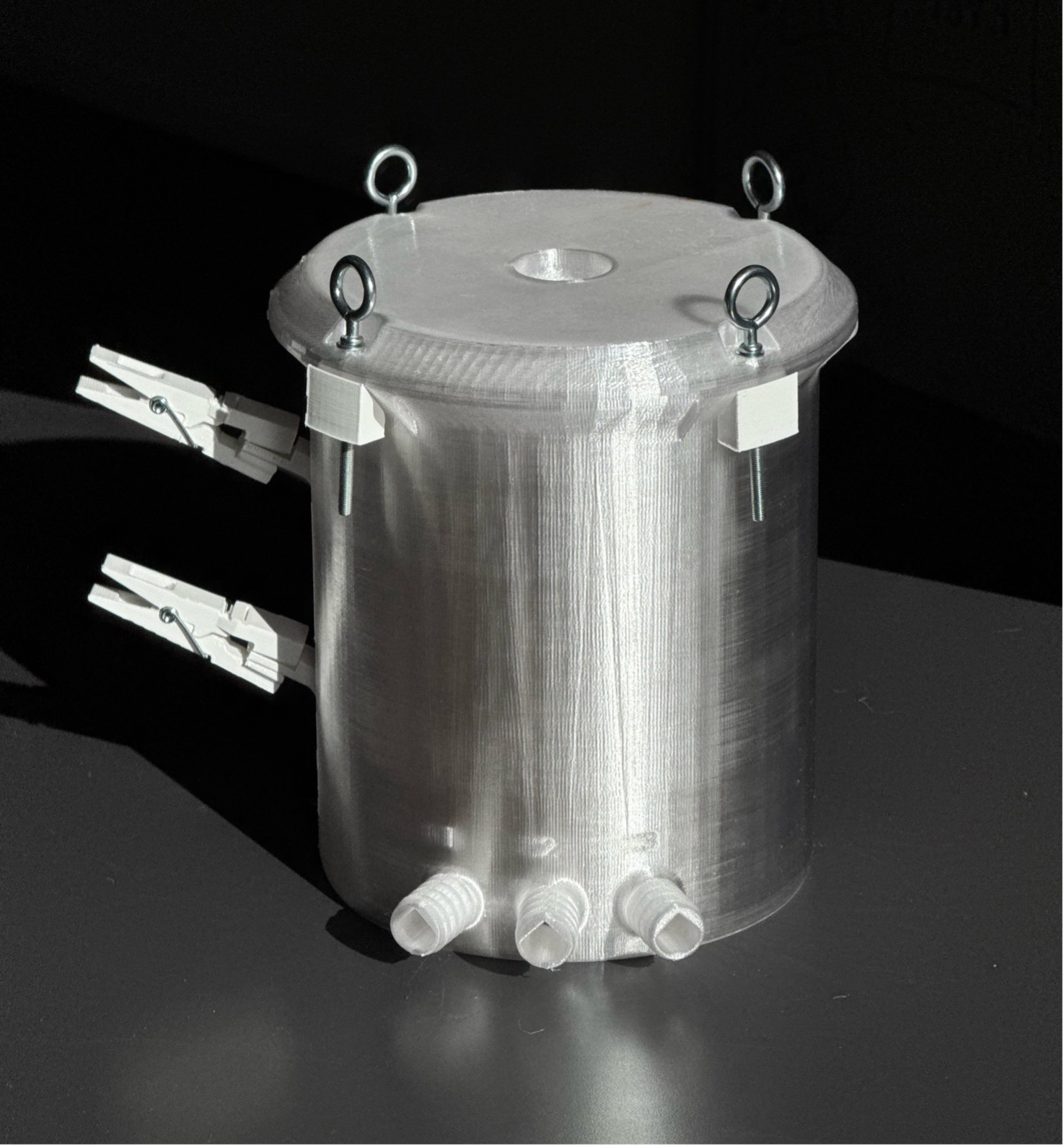
Final prototype of the filter
 |
THE RESEARCH TEAM |
|
TOR VERGATA |
||
Laura Micheli |
||
 |
Associate professor of Analytical Chemistry at the Tor Vergata Rome University, Department of Chemical sciences and Technologies. She developed an electrochemical approach to detect the composition of materials and produces silk-screened electrodes for their identification; in the project she is responsible for the development of a sensor to electrochemically identify and quantify the textile fibers collected from the filter in the washing machine wastewater. |
|
Claudia Mazzucca |
||
|
Associate professor of Physical Chemistry at the Tor Vergata Rome University, Department of Chemical sciences and Technologies. Her research activity is focused on the characterization/identification of materials using FTIR spectroscopy; in the project she is the responsable for the development of the identification method of textile fibers composition and of a specific database for all the possible textiles collected in the washing machine wastewater. |
 |
|
Chiara Balestrieri |
||
 |
Research Fellow of the Project. She is able to identify the composition of materials with an electrochemical approach, and works on the electrochemical detection of textile fibers present in washing machine wastewater using electrodes printed on screen and combined with portable and miniaturizable instrumentation. |
|
Antonio Licheri |
||
|
Research Fellow of the Project. He is involved in the characterization and determination of composition of textile fibers by FTIR spectroscopy. He collaborate to the set up of a dedicated database for the identification of textile fiber composition collected from the washing machine wastewater. |
 |
|
POLITECNICO DI MILANO |
||
Fiammetta Costa |
||
 |
Associate Professor of Industrial Design, Politecnico di Milano, Department of Design. Her research deals with environmental design and user research. In the project she deals with ecodesign and life cycle of the filter system. |
|
Attilio Nebuloni |
||
|
Researcher in Architectural Design at Politecnico di Milano, Department of Design. His research deals with Computational Design and environmental sustainability applied to architecture. In the project he is involved in the study and development of the microplastic filter. |
 |
|
Matteo Meraviglia |
||
 |
PhD student in Design at the Politecnico di Milano, Department of Design. His research activity focuses on Biophilic Design and on the study of computational methods, approaches and tools for the design of living spaces integrated with nature. In the project he is involved in the study and development of the biofilter. |
|