

DEVELOPMENT OF THE WASTEWATER REHABILITATION SYSTEMS AND EVALUATION OF THE CHEMICAL/BIOLOGICAL CONTAMINANT ABATEMENT
This research activity, given the failure to produce a microbial consortium and the good biodegradability of the wastewater, has been devoted to an alternative way to reuse wastewater. To this end trials were conducted, involving direct irrigation of edible plants grown in soil. This approach was newly introduced into the trial to evaluate the possibility of directly upcycling the wastewater for plant irrigation/fertilization, as the project's goal was to recover the wastewater. Based on the results of the chemical analyses performed, it was possible to repurpose the recovery process, using the wastewater as a fertigation system to grow edible plants. Indeed, the wastewater showed a low COD/BOD5 ratio, which allowed it to be defined as perfectly biodegradable.
Soil tests were conducted with Lactuca sativa (L.) plants; the tests demonstrated that plants watered with the wastewater actually grew very well, much better than those watered with the same tap water used to produce the wastewater (control). Indeed, the total fresh weight of leaves and roots, and the size of roots and rosettes were significantly greater, as shown in the image below.
Plants watered with tap water or wastewater of white laundry (after 40 days).
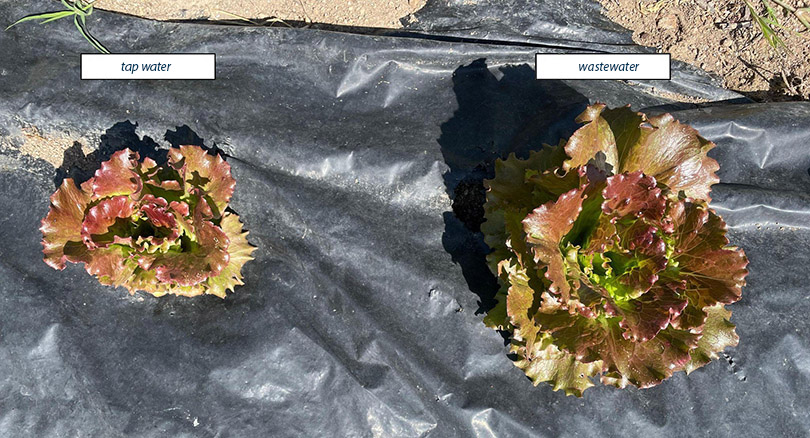
This result depends on the amount of beneficial macro- and micronutrients present in the wastewater (i.e., total nitrogen, phosphorus, and potassium, as well as iron, copper, and zinc). Plants watered with wastewater grew significantly more than controls, but maintained very good organoleptic characteristics: in fact, the concentrations of ascorbic acid, total phenols and flavonoids, chlorophylls, carotenoids, and soluble solids are similar to or higher than those of the control.
Therefore, despite the need to change the wastewater upcycling approach during the project, this experiment has allowed us to identify a new way of using wastewater, which perfectly fits with the project's purpose: in fact, the recovery and reuse of urban greywater is maintained, and the new solution represents an effective proposal for reducing water consumption and wastewater production, reducing environmental externalities and human impact within a circular economy framework (Feeny et al., 1990). The advantages of this solution are reflected, in perspective, in urban environments characterised by an increasingly close integration between greenery and architecture (Specht et al., 2014), a strategy to improve the energy efficiency of buildings in accordance with the Sustainable Development Goals of the United Nations 2030 Agenda for Sustainable Development (Schroeder et al., 2019).
 |
THE RESEARCH TEAM |
|
|
Luciana Migliore |
||
 |
Associate Professor of Ecology and Ecotoxicology at the Tor Vergata Rome University, Department of Biology. Her scientific activity focuses on both fundamental and applied ecology, by using biotechnological techniques and approaches for both the rehabilitation of contaminated matrices and for the study of biodeterioration processes. In the project she deals with both the processes for the rehabilitation of the wastewater and the management part, being the PI of the project. |
|
|
Roberto Braglia |
||
|
Coordinator of the Botanical Garden of the University of Rome “Tor Vergata”, he carries out teaching and research activities in Botany, including phytoremediation of wastewater with macrophytes. In the Zero Mile© system project, he developed the evaluation of the reuse of treated waste water from dishwashers. In this project he deals with the evaluation of the effectiveness and healthiness of the reuse of treated and untreated washing machine wastewater. |
 |
|
|
Annamaria Alabiso |
||
 |
Research fellow of the project. PhD in Biology and Evolutionary Ecology from the University of Rome Tor Vergata, she defendeda thesis focused on the development and implementation of the biofilter for the Zero Mile© system, an ad hoc engineered microbial consortium for the recycling of dishwasher wastewater. |
|