

LIFE CYCLE ANALYSIS OF THE VALORIZATION CHAIN PROPOSED BY THE PROJECT.
This line of activity aimed to identify and quantify the potential environmental benefits (or additional impacts) resulting from the application of the proposed treatment and recovery processes considered within the project. Specifically, life cycle assessment (LCA) was selected as the assessment methodology, following the procedure described in ISO 14040-14044 standards. Some of the main environmental impacts related to three comparative scenarios were quantified and compared, as shown in the figure below.
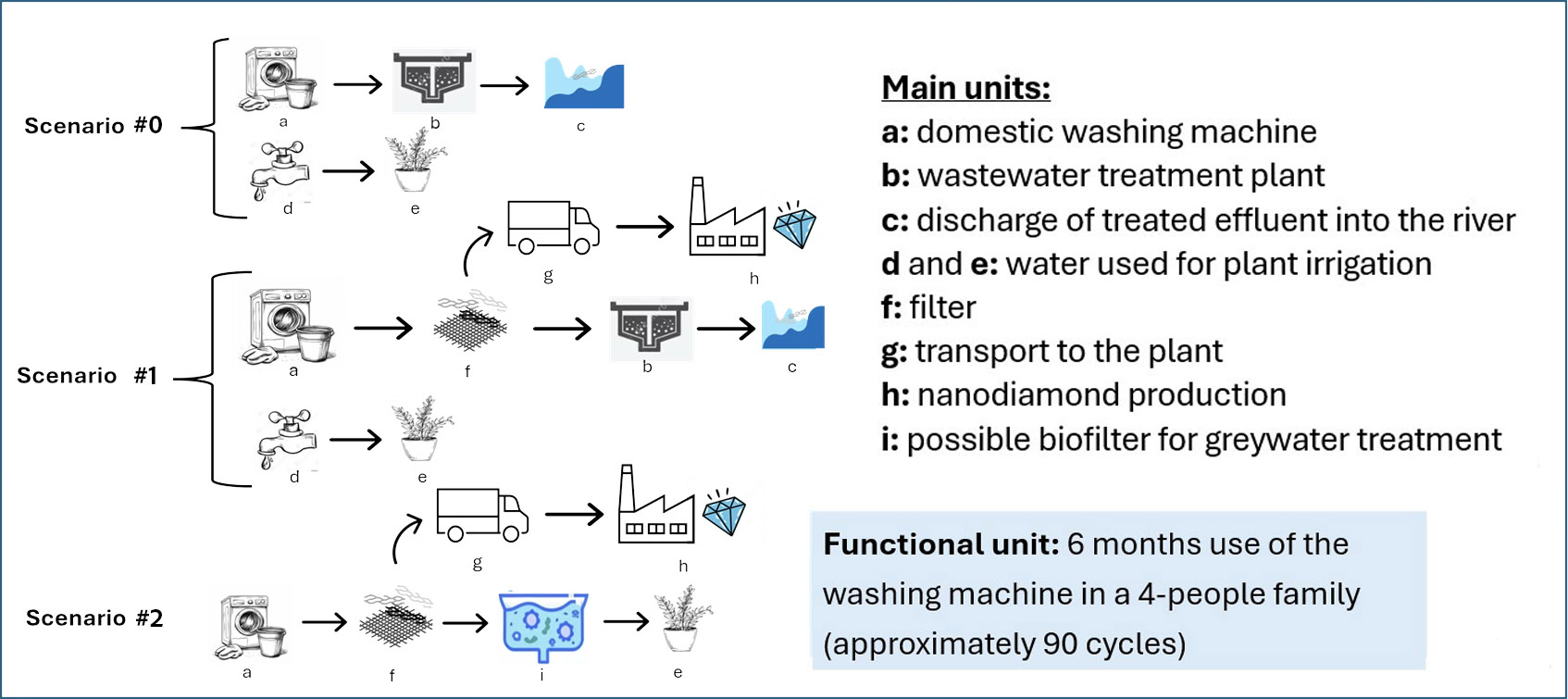
Schematic representation of the three scenarios considered and of the selected functional unit.
The baseline scenario considered the typical use of a domestic washing machine, including the fate of wastewater. The first alternative scenario considered the treatment of washing machine wastewater at the end of the cycle through filtration and the valorisation of the synthetic fibres collected in the filter, to produce nanodiamonds in dedicated plants. Finally, the second alternative scenario considered the reuse of treated water for domestic irrigation, in addition to the upcycling of synthetic fibres. The individual impacts resulting from the sub-processes considered in each of the three scenarios were modelled to identify the most critical aspects in terms of environmental impacts and determine the weight of each of the units considered. This allowed us to propose alternative options that could reduce the environmental impacts associated with the process and, in general, the scenario considered. This assessment was carried out through a sensitivity analysis conducted assuming two improvement scenarios: the first relating to an increase in filter removal efficiency, and the second relating to an increase in the volume of water reused at the domestic level. It should be noted that this line of research has worked closely with that related to social and economic impact assessment, jointly defining both the baseline scenario in terms of social and economic aspects, as well as the environmental ones, and the possible application contexts of the nanodiamond production technology, starting from synthetic fibres, which may present the best potential from a technical-economic, as well as environmental and social perspective, given that the active involvement of consumers is a fundamental aspect of the proposed valorisation chain.
The results of the study showed that for all environmental impact categories examined, the improved scenarios studied would lead to a reduction in impacts and, in some cases, even avoidance of impacts. Specifically, regarding the scenario of interception and valorisation of synthetic fibres into nanodiamonds, the largest reductions (over 40%) were associated with the categories of ecotoxicity impacts on aquatic organisms and toxic effects on human health. This result is related to the processes that can be avoided by adopting the proposed supply chain: in the first case, the discharge and/or runoff into receiving water bodies of effluents from domestic wastewater treatment plants containing synthetic fibres, and in the second, the production of nanodiamonds using processes typically adopted at the industrial level, which rely on the detonation of explosive materials. Other impacts such as climate change, land acidification, and the use of non-renewable resources and water showed more modest decreases due to the fact that the main contribution to these impacts comes from water and energy consumption during use of the washing machine itself.
Regarding the second alternative scenario, which considered reusing part of the washing machine wastewater for irrigation purposes, additional benefits were achieved beyond those previously described, especially with regard to eutrophication and resource consumption impacts. Finally, both alternative scenarios - implementing 90%-efficiency filtration systems and reusing all the washing machine wastewater - were shown to deliver substantial additional environmental benefits, consistent with the principles of the circular economy and the protection of aquatic ecosystems.
 |
THE RESEARCH TEAM |
|
|
Renato Baciocchi |
||
 |
Full Professor in Environmental Health Engineering at the Tor Vergata Rome University, Department of Civil engineering and computer engineering. The scientific activity is dedicated to the rehabilitation of industrial waste and contaminated sites, monitoring techniques and risk assessment in contaminated sites. In the project he deals with the evaluation of the environmental sustainability of the planned processes and the analysis of the life cycle of the various elements. |
|
|
Giulia Costa |
||
|
Associate Professor of Environmental Health Engineering at the Tor Vergata Rome University, Department of Civil engineering and computer engineering. The main scientific activity concerns the analysis of environmental behavior and the valorisation of industrial waste and residues. In the project she deals with the evaluation of the environmental sustainability of the planned processes and the analysis of the life cycle of the various elements. |
 |
|
|
Jacopo Valeri |
||
 |
Research fellow of this project. He graduated in Energy Engineering in 2024 with an experimental thesis on the evaluation of the environmental compatibility of the use of construction and demolition waste as aggregates in civil works. In the project, he deals with LCA (Life Cycle Assessment) methodology to assess the environmental impact of a product, process or service throughout its life cycle. |
|